
|
 |
West Links - North Berwick
Advanced Booking Course History Views Score
Card |
|
North Berwick Golf Club
Beach Road, North Berwick
General Manager: Stuart Bayne
secretary@northberwickgolfclub.com
![[13th on West Links]](images/W13sml.jpg) |
13th 'Pit' on West Links
© Digitalsport UK
![[14th on West Links]](images/W14sml.jpg)
| 14th 'Perfection' on West Links
© Digitalsport UK |
| | West
Links Golf Course
By Douglas Seaton
North Berwick Factfile
![[sign]](images/signT.jpg) HE WEST LINKS was originally six holes and a seventh was
added before it was extended to 18 holes in 1877. By 1895 the course was lengthened, and today measures 6506 yards S.S.S 71. Not
the longest, but the trickery of the course requires the full repertoire of shot making. A true links course laid out on a
raised-beach, laden with brown sand forming the undulating links land 10 to 30 feet above sea level.
The course has been described as from a 'Primitive Age' relating to a period from the beginning of the game to the invention of
the gutta-percha in 1848. The West Links is of great antiquity and has it's place among a very special group of courses which
evolved naturally and owe little to the hand of man.
HE WEST LINKS was originally six holes and a seventh was
added before it was extended to 18 holes in 1877. By 1895 the course was lengthened, and today measures 6506 yards S.S.S 71. Not
the longest, but the trickery of the course requires the full repertoire of shot making. A true links course laid out on a
raised-beach, laden with brown sand forming the undulating links land 10 to 30 feet above sea level.
The course has been described as from a 'Primitive Age' relating to a period from the beginning of the game to the invention of
the gutta-percha in 1848. The West Links is of great antiquity and has it's place among a very special group of courses which
evolved naturally and owe little to the hand of man.
A golfing experience not found anywhere else, with blind holes, drives over walls and burns, shots over the bay and bunkers deep
enough for the golfer to disappear from view. Many of the holes have been copied by designers all over the world, including the
374 yard 14th named 'Perfection' and the 190 yard 15th called 'Redan'. All the holes have fascinating names such as Mizzentop,
Bos'ns Locker, the Pit and Linkhouse, the eighth hole which has 13 bunkers to negotiate.
Point Garry (out) is the first hole and at one time shared the green with the 17th Point Garry (in). This double-green was described by
Bernard Darwin, the doyen of golf writers as a " Terrible place where the green slopes away to the rocks and beach." Although not as
daunting as in Darwin's day, the opening and finishing stretch requires some thought.
The Bass Rock Golf Club (1873), Tantallon Golf Club (1853) and North Berwick Golf Club (1832) all play over the West Links. The
latter is the thirteenth oldest golf club in the world and second only to the Royal and Ancient Club in St Andrews for continuous
play over the same course. |
| Booking: Tel 01620 892135 Fax 01620 893274
|
|
![[Bunker at 10th
hole]](images/bunkersml.jpg)
Traditional revetted bunker face
© Digitalsport UK
![[lamps]](images/12thTee.jpg)
12th 'Bass', 401yard,Par 4
© Digitalsport UK | |
Today the visitors can relive the most famous challenge match of all time, played at North Berwick in 1849 between Allan Robertson and
Tom Morris against the Dunn brothers Willie and Jamie, for a purse of £400. The matches were played over Musselburgh, St Andrews
and North Berwick, 36 holes on each course.
Following the matches at Musselburgh and St Andrews the game was all-square leaving the final
result to be decided at North Berwick. Odds of 20 to 1 were freely laid on the brothers who were favourites with the backers as they held
the lead four up and eight to play but Robertson and Morris fought back winning four of the next six holes.
At the penultimate hole (the present 17th) at North Berwick, Allan drove the ball 130 yards, landing in a thick clump of grass. Tom
hacked it out, but two shots later he and Allan lay four in the bunker in front of the green. The Dunns lay twenty yards away for two,
but their ball came to rest on the cart track to the right of the fairway. The Dunn's took three shots to get out of the cart track,
eventually using the back of the club to move the ball. Robertson and Morris won the hole and when Robertson sunk his putt at the last
for a win, the tall figure of Sir David Baird, umpire for the day, then declared the St Andrews men winners by 2 holes. The visitors
can relive those shots from over 165 years ago with the bunker in front of the seventeenth green 'Point Garry (in)' and the cart-track
to the right, still an integral part of the course, where the Dunn brothers came to grief.
The West Links is one of the qualifying courses when the Open Championship is played at Muirfield, and over the years has
hosted the British Senior's Open Championship, Scottish Boys' Championship (1935-1972), Vagliano Trophy and several Scottish
Professional Tournaments.
Among North Berwick's famous golfers was Ben Sayers who had a successful professional career before establishing a golf club
manufacturing business in 1883, which continued to produce innovative golf clubs for over 120 years. The clubmaker Thomas Dunn
first worked on the West Links in 1869 as a greenkeeper.
West Links Score Card |
|
Course Record Pro 63: Trevor Immelman Am 63: Joe Lockie 2016
|
|
The present pro's shop beside the first tee was designed by Tom Dunn in 1888 as his clubmakers workshop, with lockers for rent
by visiting golfers. The adjacent building was the caddie shed where the Caddie Master organised his flock. Among the caddies
were Jack Hobens and James R. Thomson who in 1916 were founder members of the PGA of America, and Hobens helped to draft the
constitution.
Tom Anderson was the first to be appointed to the new position of head greenkeeper in 1890. He had responsibility for collecting
the visitor green fees, organising the starting times and supervising the course maintenance. His son Willie Anderson won the US
Open four times. Jack White captured the British Open in 1904, and a month later Willie Anderson won the US Open, both national
titles were in the hands of North Berwick men. A remarkable achievement for two clubmakers from such humble beginnings.
Golf World Top 50 Scottish Courses: North Berwick
ranked 5th in 2021
Fred McLeod, a North Berwick postman won the 1908 US Open and from 1963 was by
tradition first off the tee to begin the Augusta Masters each year. Another North Berwick postman, Jack Forrester qualified for
the 1921, 1923 and 1924 PGA Championship of America and for a decade of US Open's was never out of the top twenty.
The finest amateur golfer from North Berwick was Dorothy Campbell, the only player ever to win four national championships at the
same time, - Canadian, Scottish, British and American titles. Dorothy lived with her mother and sisters in Inchgarry House opposite
the 18th tee on the West Links. Over 80 years would pass before another North Berwick girl Catriona Matthew won the Centenary
British Amateur Championship in 1993. Catriona is currently competing on the LPGA Tour and won the Ricoh Women's British Open in 2009.
One of the earliest golf pro's to emigrate from the town was Harry Gullane who laid out the courses at West Chester Golf and
Country Club and St Davids in Pennsylvania. Robert Johnstone opened up golf in the North West, laying out the course at Seattle,
while George Turnbull who often played in a 'Palm Beach Suit' was hired by more golf clubs than any other pro in his short but
colourful life. Jimmy Thomson at the age of sixteen began to compete on what was to become the US PGA Tour. He was runner-up in
both the 1935 US Open and 1936 PGA Championship and appeared in the movie 'The Caddy' with Dean Martin and Jerry Lewis. His father
Wilfred Thomson was the last of the traditional teaching professionals on the West Links in the 1950s.
|
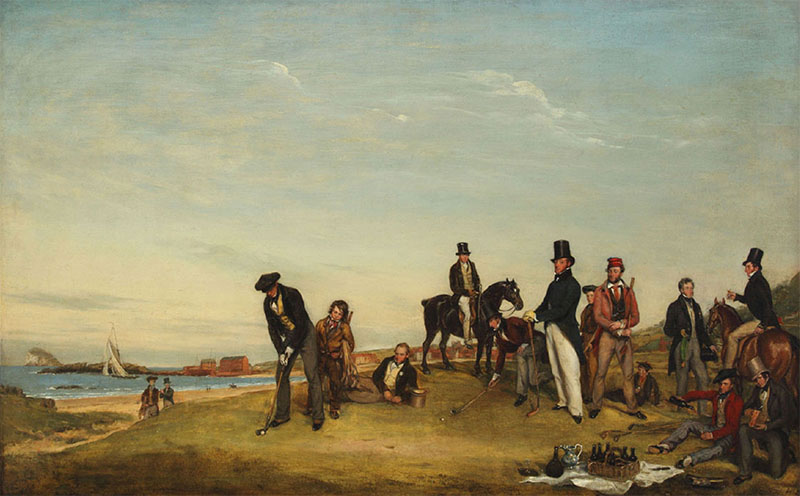 |
| The original painting of the 'First Meeting of the North Berwick Golf Club' in 1835
by Sir Francis Grant, R.A. is now hanging above the fireplace in the Charles Blair Macdonald Room in The Links Club, New York.
|
|
Famous Redan Hole Like many of the great holes in golf, first impressions of the 190 yard, par 3 15th are deceptive,
and only by playing the hole several times does it reveal it's hidden subtleties. The mounds, ridges and depressions left after
the sea receded gives the West Links it's natural contours and the 'Redan' was part of that evolution. In those days the
constraints of the feathery ball determined the length of each hole and the green was positioned on the nearest flat ground.
Often a ridge crossing the path of play was used for the green and that is how the 'Redan' was created by nature. The green is
laid out on a diagonal sloping plateau with bunkers on the face of the ridge and under the shoulder of the green, on the left and
right. The 'Redan' came into play as the 6th hole in 1869 when the course was extended over a stone wall known as the March Dyke
to make nine holes. |
North Berwick is the fourth oldest to make reference to golf
St Andrews (1552), Leith (1593), Perth (1604) and North Berwick (1611) |
|
he name 'Redan' comes from the Crimean War, when the British captured a Russian held fort or in the local dialect, a redan. John
Whyte-Melville a member of North Berwick Golf Club in 1833 and a serving officer is credited on his return as describing the 6th
like the formidable fortress or redan he had encountered at Sebastopol. Conquered only after nearly a year of attrition which
left over 20,000 British soldiers dead and four times as many French. The word 'Redan' is now part of the English language,
and the definition given by the Oxford Dictionary is 'Fort - A work having two faces forming a salient towards the enemy.'
The Redan became the 15th hole when the course was extended in 1877. At that time the 14th was a short hole measuring 176 yards
with the green situated in front of the present 'Perfection' cross-bunker. The 15th tee was on the sand dune above, and according
to Horace Hutchinson, a cleek or iron shot was used to pitch just over a wall, so far and no further, and then a full drive or
brassy shot to carry over a bunker escarpment not inaptly called 'the Redan'. The hole measured 266 yards in 1895 before the
teeing ground was moved forward.
In November 1889, the bunkers were strengthen with railway sleepers (railroad ties) to allow the green to be enlarged. The green
is blind from the tee and the player has to shape the shot into the prevailing wind, allowing for the ball to finish below the
flag stick. The slope of the green runs diagonally from right to left, and anything above the hole is in three putt country. The
bunkers on two sides, deep enough for the player to disappear from view add to the difficulty of securing par. The wind
direction plays an integral part on every hole and the 192 yards can be covered from an eight iron to a driver, depending
on the conditions.
|
![[Redan 15th West Links]](images/redan3.jpg) | | 'Redan' with the March Dyke, Craigleith island and Bass Rock in the background © Digitalsport UK
|
| The 16th hole, named 'The Gate', a 314 yard, par 4, has the most unique green in Scotland. The
drive from the tee over a stone wall, has to clear a burn crossing the fairway at 195 yards. The green has a deep swale bisecting
the middle and the extended green came into play in October 1895. This was the green where Phil Mickelson practiced his putting
during the 2013 Open Championship at Muirfield while staying in the Marine Hotel overlooking 'the craziest green in the world'
as Mickelson described it. Ladies Links
The Ladies Course at North Berwick with bunkers and greens is the oldest
nine-hole ladies course in Scotland, laid out in 1867. The Ladies Club was formed twenty years later, when Tom Dunn redesigned
the course. In 1888, William Law, the overseer at Auchiewillie Farm, Dunoon was appointed green-keeper on the Ladies Course. He
was the father-in-law of Tom Anderson head green-keeper on the West Links. Until 1935 the Ladies employed their own greenkeeping
staff and were responsible for the lease of their own course. They had a timber clubhouse in the grounds of the Marine
Hotel. Today their course is called the Children's course situated adjacent to the 16th fairway. The Ladies play all their
competitions over the West Links and in 2005, became full members of the North Berwick Golf Club.
Since the 1860s the Visitor's Golfing Association held competitions for juveniles over the Ladies course and the seven-hole
West Links, organised by James Lewis and secretary James Bryson. In August 1867, Major A.V. Smith Sligo organised the first
competition for boys over ten but under fifteen years of age. Played on the short or Ladies course with bunkers and greens but
no record has been kept of the prize winners. The following year Lord Elcho donated a silver medal for the best handicap score
and the first winner was 13 year old Andrew Peacock. The Elcho Medal for boys under fifteen years is still contested today and
is the oldest open junior golf competition in the world.
David Huish the golf professional and course manager at North Berwick for over forty years retired in April 2009 and was
succeeded by his son Martyn Huish who heads up the club's teaching programme. Martyn has worked for his father as assistant
since 1989. He has a first class reputation as a teacher, and as a club pro.
Course Manager
Darren McLaughlan was appointed West Links Course Manager on 5th October 2020. He has a wealth of experience, including working
at Machrihanish Golf Club and more recently Montrose Golf Club where he held the position of Course Manager. Darrenn's career
has spanned from Ayrshire to the La Force Country Club, Miami Beach, Florida then to Wentworth where he organised the BMW PGA
championship. Darren McLaughlan resigned in August 2022 when he took up a position at Turnberry Golf Club. Kyle Cruickshank
replaced him as Course Manager on the North Berwick West Links in October 2022.
Stuart Bayne was appointed General Manager of North Berwick West Links in February 2023. Originally from Yorkshire, Bayne has been
at Archerfield for the past seventeen years. After graduating with a business degree he took up a job at Foxhills in Surrey
alongside Alasdair Good. When he moved to Gullane as the head professional he offered Bayne the opportunity to join him in East
Lothian. Stuart Bayne spent two and-a-half years working at Gullane before moving to Archerfield Links.
|
|
"Drive the ball over Robert Louis Stevenson's Cressy Burn"
|
|
Charles Stevenson the cousin of Robert Louis Stevenson wrote about the holidays they shared at North Berwick. The Longskelly beach
and Eil Burn (called the Cressy Burn in RLS's novel Catriona) was a favourite play area. In the 1860s the burn lay a mile west of
the end of the golf course but today the Eil Burn is an integral part of the course, cutting through the 7th and 12th fairways.
" That part of the beach was long and flat, and excellent walking when the tide was down; a little cressy burn flowed over it in
one place to the sea; and the sandhills ran along the head of it like the rampart of a town. No eye of ours could spy what was
passing behind there in the bents, no hurry of ours could mend the speed of the boat's coming: time stood still with us through
that uncanny period of waiting."
Many well known celebrities have played the North Berwick West Links but none more humble than Neil Armstrong. To celebrate Neil's
eightieth birthday three of his colleges arranged for Neil to play the West Links. He was such a quiet and unassuming gentleman his
party were on the third tee before his caddie recognized the most famous astronaut in the world. Playing with three friends Neil
was described as a very polite and quiet spoken man who enjoyed his round of golf at North Berwick in October 2010.
SCOTTISH BOYS CHAMPIONSHIP
The Scottish Boys Championship was first held at North Berwick in 1935. Bryan Thomson an apprentice clubmaker with Ben Sayers
& Son was the first local to win the championship in 1952. The Sky Sports golf commentator Ewan Murray won the Scottish Boys
Championship at North Berwick in 1971. Murray attended Currie High School in Edinburgh and the previous year he lost the final
of the British Boys at Hillside, one up and two play.
After 43 years the Scottish Boys Championship moved to Dunbar in 1978 when Brian Marchbank a member of Auchterarder emerged
victorious in the events' first staging at Dunbar. Marchbank beat John Cuddihy from West Lothian who was the British Boys
champion at the time having beaten Sandy Lyle in final to claim the title. John Huggan a member of Winterfield won the
championship in 1978.
Andrew Coltart who went on to become a European Tour winner and Ryder Cup player was representing Thornhill when he triumphed in
1987 after extra holes. Another local was Grant Forrest representing Craigielaw won the championship at West Kilbride in 2000,
before he joined the European Tour.
Coastal Erosion
During the winter of 2018-19 the Green Committee addressed the problem of coastal erosion on the West Links. The maintenance
work included replacing the sand dunes washed away during a storm in 2016 as well as replacing sections of the sleeper wall
by the second fairway. The work also included an ecological study which discovered a family of otters which were protected
throughout the erosion works. Images of the works are available on the Erosion
Page
| | Designers inspired by the West
Links, North Berwick |
| Designer | Course |
West Links |
| George C. Thomas |
Riviera Country Club, California
4th hole
(238 yards, Par 3). | 15th
hole,(192 yards)
" Redan " |
| Charles Blair
Macdonald | National Golf
Links, Southampton, N.Y.
4th hole (197 yards Par 3). | 15th hole,(192 yards)
" Redan
" |
| Donald Ross |
Seminole, North Palm Beach, F.L.
18th
hole. | 11th hole, 550 yards, Par
5,
" Bos'ns Locker " |
| Willie Dunn Jnr. |
Shinnecock Hills, Long Island, N.Y.
7th
(189 yards) and 17th (180 yards) | 15th hole,(192 yards)
" Redan " |
| Seth Raynor |
Fishers Island, Long Island, N.Y.
2nd
hole (170 yards) | 15th
hole,(192 yards)
" Redan " |
| Harry S. Colt |
Toronto Golf Club, Ontario, Canada.
4th
hole (190 yards, Par 3) | 15th
hole,(192 yards)
" Redan " |
| Willie Campbell |
Brookline Country Club, MA
12th hole
'Redan' (130 yards, Par 3) | 15th
hole,(192 yards)
" Redan " |
| Jack Nicklaus |
Valhalla Golf Course, Louisville, K.Y.
16th hole (444 yards, Par 4) | 16th hole (381 yards, Par 4)
" Gate " |
| Seth Raynor |
Morris County Golf Club, NJ
13th hole
(178 yards, Par 3) | 15th hole
(192 yards)
" Redan " |
| Robert Trent Jones
II | Poppy Hills,
Monterey, C.A.
15th hole (193 yards, Par 3) | 15th hole,(192 yards)
" Redan " |
| Seth Raynor |
Fishers Island, Long Island N.Y.
5th
hole (225 yards, Par 4) | 16th
hole (318 yards, Par 4)
" Gate " |
| Albert W.
Tillinghast | Somerset
Hills Country Club, N.J.
2nd hole (180 yards, Par 3) | 15th hole,(192 yards)
" Redan " |
| Charles Blair
Macdonald | Mid Ocean
Golf Club, Tucker's Town, Bermuda
5th hole (433 yards, Par 4) | 2nd hole,(431 yards)
" Sea " |
| Dr. A. MacKenzie |
Alwoodley Golf Club, Leeds, Yorkshire
14th hole (206 yards, Par 3) | 15th hole,(192 yards)
" Redan " |
| Harry S. Colt |
Swinley Forest, Ascot, UK
4th hole (185
yards, Par 3) | 15th hole,(192
yards)
" Redan " |
| Seth Raynor |
Fox Chapel Golf Club, Pittsburgh. P.A.
6th hole (192 yards, Par 3) | 15th hole,(192 yards)
" Redan " |
| Devereux Emmet |
Trump National Golf Club, Briarcliff Manor NY.
9th
hole (446 yards, Par 4) | 16th
hole (318 yards, Par 4)
" Gate " |
| Charles Blair Macdonald |
Greenbrier - The Old White TPC. WV
8th hole (217 yards, Par 3) | 15th hole,(192 yards)
" Redan " |
| Peter Thomson |
Ocean Course, National Golf Club, Victoria,
AUS.
11th hole (186 yards, Par 3) | 15th hole,(192 yards)
" Redan " |
| Charles Banks |
Oneck Course, Westhampton Country Club,
N.Y
9th hole (190 yards, Par 3) | 15th hole,(192 yards)
" Redan " |
Seth Raynor and
Charles Blair
Macdonald | Gibson Island
Club, Maryland
3rd hole (181 yards, Par 3) | 15th hole,(192 yards)
" Redan " |
| Jack and Gary
Nicklaus | Prospector
Course, Superstition Mountain, AZ
17th hole (192 yards, Par 3) | 15th hole,(192 yards)
" Redan " |
| Charles Blair
Macdonald | Lido Country
Club, Lido Beach, N.Y
16th hole (216 yards, Par 3) | 15th hole,(192 yards)
" Redan " |
| Seth Raynor |
Oakland Country Club, N.Y
13th hole (190
yards, Par 3) | 15th hole,(192
yards)
" Redan " |
| Pete Dye |
Kiawah Island Ocean Course, S.C
17th hole (221
yards, Par 3) | 15th hole,(192
yards)
" Redan " |
| Charles Blair Macdonald |
St Louis Country Club, MO
16th hole (183
yards, Par 3) | 15th hole,(192
yards)
" Redan " |
| Jack Nicklaus |
Spring Creek Ranch, Collierville, TN
8th
hole (190 yards, Par 3) | 15th
hole,(192 yards)
" Redan " |
| James Tinlin |
Mount Lawley Golf Club, Perth, AUS
15th
hole (178 metres, Par 3) | 15th
hole,(192 yards)
" Redan " |
| Seth Raynor, Tom Doak
| Yeaman's Hall Golf Club, SC
6th
hole (180 yards, Par 3) | 15th hole,(192 yards)
" Redan " |
| Ernie Els |
Four Seasons Anahita Golf Course, Mauritius
8th hole
(429 yards, Par 4) | 13th hole,(387 yards)
" Pit " |
| James E. Tinlin/Carl Klem |
Mount Lawley Golf Club, Western Australia
8th hole
(443 yards, Par 4) | 16th hole,(318 yards)
"Gate " |
|
Left to Right: George Thomson, John R. Whitecross, Edward Blyth, George Sayers, Ben Sayers,
Jimmy Glass, Peter Brodie, Rev. FLM Anderson, Peter Brodie Jnr. Jack White, Robert Johnstone,
(Speeder), Rev.Valentine (visitor). Putting on the 17th green circa 1895
|
| Driving from the North and Edinburgh Airport From
Edinburgh take the A720 City By Pass (South) - follow sign post Berwick-Upon-Tweed (A1). Continue on A1 (South) and take the A198
- sign post North Berwick. Pass through the villages of Longniddry, Aberlady, Gullane to North Berwick. Then follow signs for Town
Centre and Golf Course. Drive time from Queensferry Crossing and Edinburgh Airport 45 minutes.
Driving from the South From the A1 motorway take the A198 - sign post North Berwick. |
| Copyright © Douglas C. Seaton 1994 - 2021, All Rights Reserved. |
|


![[17th Green]](images/17thGreen.jpg)